
The Central Bank of Brazil imposed an urgent deadline:implement identity verification to comply with new regulations.
We launched it: on time, compliant, live.But 79% of users dropped off at the critical verification step.
This is how I turned that around: a 357% increase in verification rate.
A case study documentaryPagar.me · 2022
Background checks and facial biometrics
TL;DR
We launched identity verification on time for a Central Bank of Brazil deadline, then found that 79% of users dropped off at the personal data step. I redesigned the modal to explain why verification mattered before asking users to act. In an A/B test against the original, it lifted the verification rate from 14.47% to 66.25%, a 357% uplift.
+357%
Verification rate
+167%
Modal CTR
−9.6s
Time to convert
2,800+
Merchants verified
Context
I was the only designer, working with product managers, engineering, legal, and marketing to meet the Central Bank of Brazil deadline.
Engineering had limited resources. Legal needed specific language.
There was no room for a robust notification system, so I used an existing modal component and worked with legal and marketing to make the language readable.
The modal could only appear when a user tried to open a financial product, so users who never went there never saw it. We accepted that limit to launch on time without backend changes.
Original version2022
Finding the real problem
Three months after launch, the modal was underperforming.
I ran funnel analysis, heatmaps, and session recordings to find where users were actually dropping off. The data showed two patterns. Users were either:
- Closing the modal immediately, treating it like an ad and never starting the flow, or
- Clicking through without reading, reaching the personal data page without understanding why they were there, then dropping off.
The personal data page had a 79% drop-off rate.
Only 21% of users were reaching the address page.
- Modal
- Contextualization
- Personal data79% drop-off
- Address page21% continue
- Facial biometrics
- Conclusion
The redesign
I had to fix it within the same constraints:
- It had to stay a modal.
- No backend changes.
- The legal language had to stay the same.
Collaborative ideation
I ran a collaborative session with the design team to explore improvements within those limits.
The main goal: increase awareness of why verification mattered before asking users to act.
Collaborative ideation2022
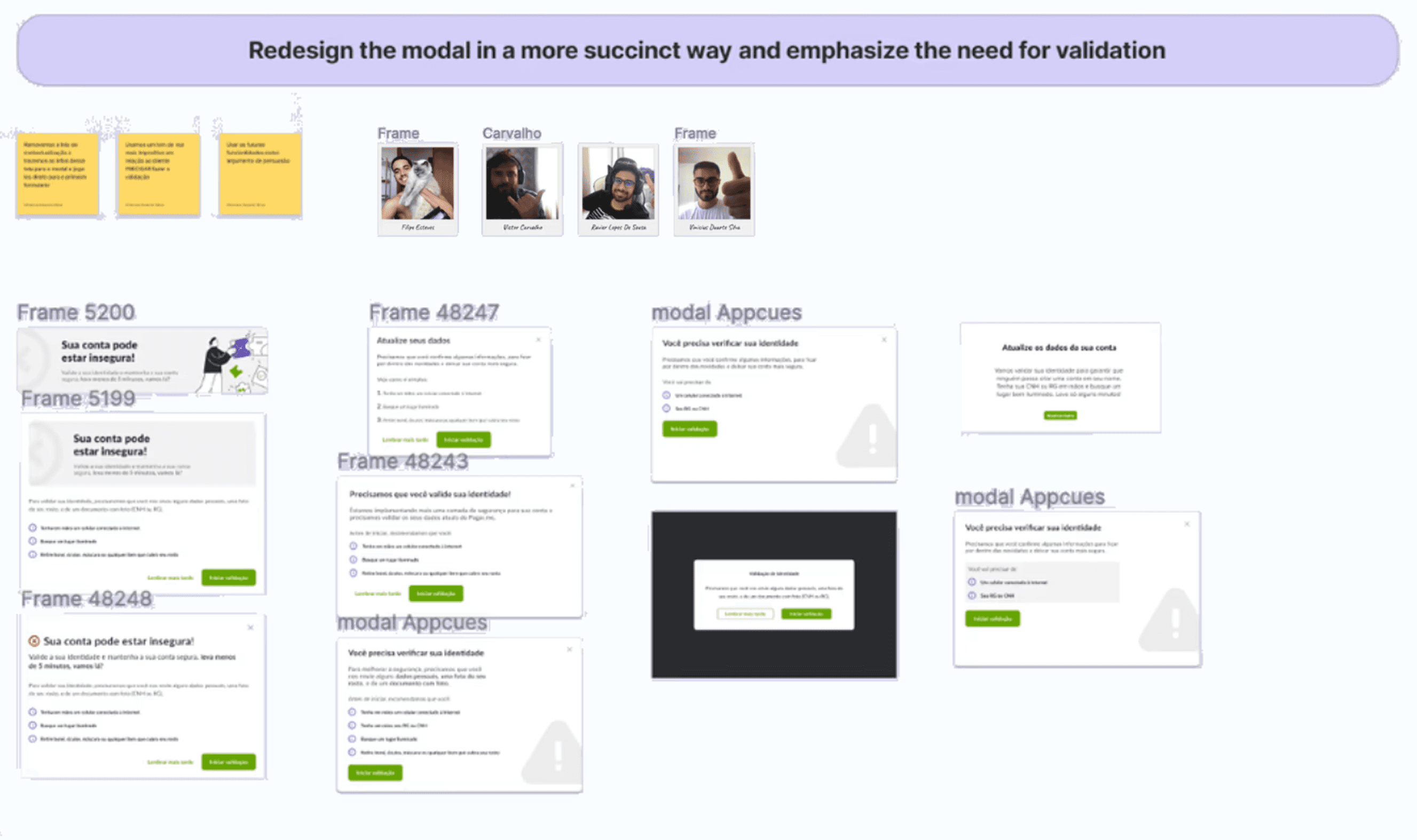
Ifthe modal gives enough context and redirects users straight to the first form,
thenusers will better understand the requirement and complete verification at a higher rate.
After a design critique of about ten explorations, we chose the version below.
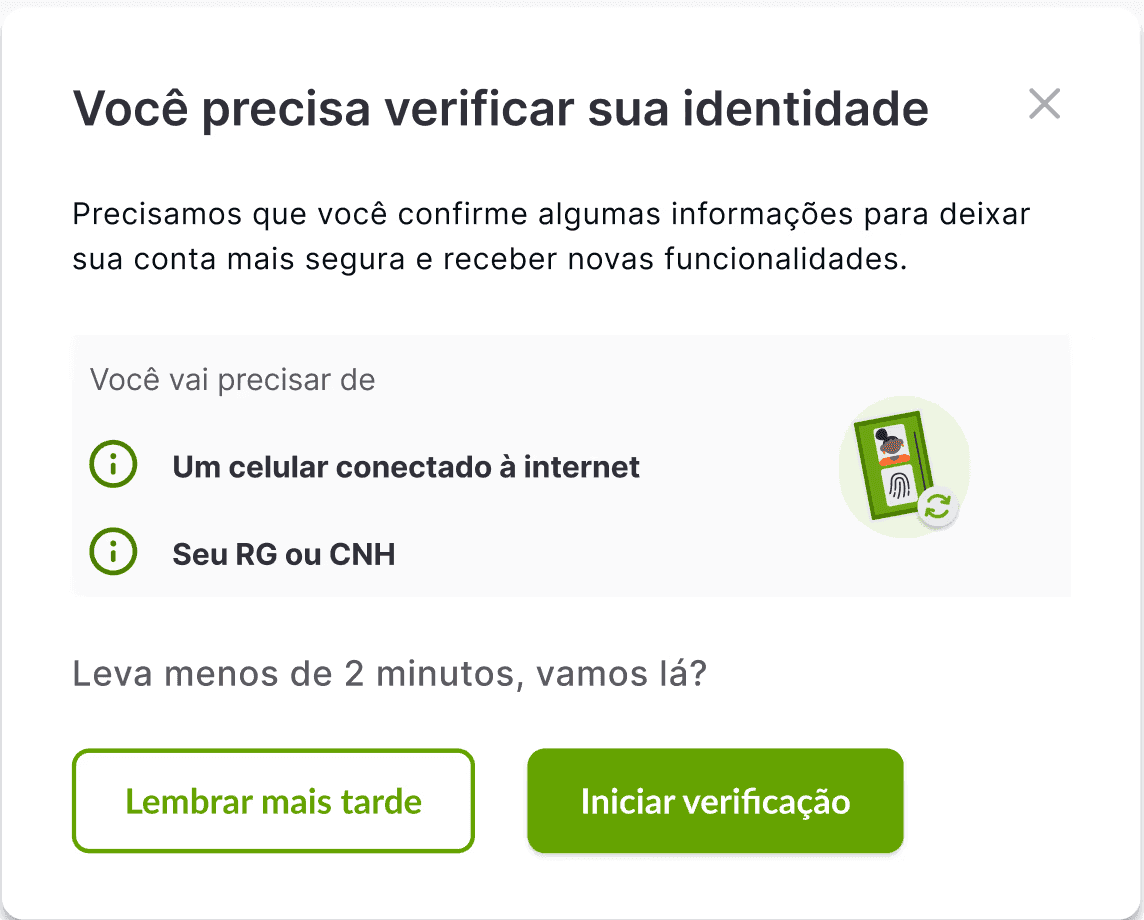
- Clearer value and actionThe second version states exactly what to do and why, reducing uncertainty and increasing click intent.
- Lower perceived effort and timeListing concrete requirements and reinforcing the short duration helps users feel the action is fast and low-commitment.
- Better visual scannability and focusA cleaner layout with icons and tighter grouping makes the key message and the primary CTA (call to action) easier to spot.
The test
When we ran the A/B test, the verification rate in the control group had dropped to 14.47%, even lower than the initial 21%. That became our baseline. The test ran for two weeks, and each variant was shown to 4,000 users.
Success criteria
Verification rate increases by at least 20% compared to the control group.
- Baseline
- 14.47%
- Users per variant
- 4,000
- Success criteria
- +20%
The results
The test variant moved the verification rate from 14.47% to 66.25%, a 357% uplift, statistically significant (p < 0.001).
Beyond that, other strong results emerged:
+357%
Verification rate
+167%
Modal CTR (click-through rate)
−9.6s
Time to convert
2,800+
Merchants verified
The winning modal was rolled out to 100% of users.
End of tape
Want to see how I would approach your product? Let's talk.